
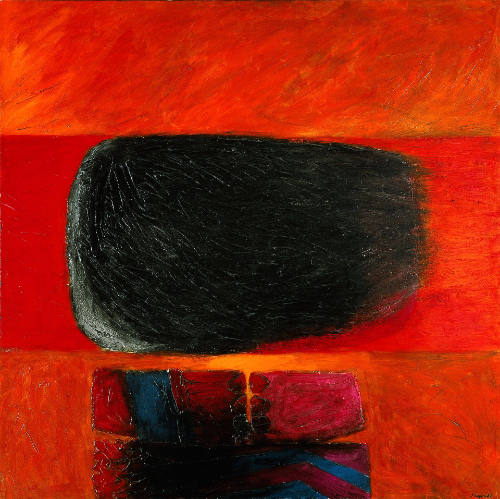

Inkarri
Primary
Fernando de Szyszlo
(Lima, Peru, 1925–San Isidro, Peru, 2017)
NationalityPeruvian, South America
Date1968
MediumAcrylic on wood
DimensionsFramed: 59 1/4 × 59 1/4 in. (150.5 × 150.5 cm)
Sight: 59 1/4 × 59 1/4 in. (150.5 × 150.5 cm)
Sight: 59 1/4 × 59 1/4 in. (150.5 × 150.5 cm)
Credit LineBlanton Museum of Art, The University of Texas at Austin, Gift of John and Barbara Duncan, G1971.3.48
Keywords
Rights Statement
Collection AreaLatin American Art
Object numberG1971.3.48
On View
On viewLocations
- exhibition BMA, Gallery, C9 - Susman Galleries
Collection Highlight
The emergence of abstraction in Peru was rejected at first by those who believed the international nature of the style would undermine their national culture. Fernando de Szyslo, a pioneer of abstraction in his country, resolved this apparent contradiction by evoking in his paintings local indigenous traditions. Inkarri refers to a well-known myth that predicts the return of Tupac Amaru, the last independent ruler of the Inca, to avenge his execution at the hands of the Spanish conquerors. The predominant blacks and reds, colors often present in ancient Peruvian textiles and pottery, suggest the notion of the “black sun” and “black rainbow” mentioned in a Quechua elegy about Atawalpa, symbolizing the last Inca Emperor before the arrival of the Spaniards. At the same time, the loose brushstrokes that define the fluid bands of color are reminiscent of Mark Rothko’s work. De Szyszlo combines ancient references and contemporary aesthetics to ground his work in Peruvian history.
Exhibitions
![Runa Macii [My Fellow Man]](/internal/media/dispatcher/20544/thumbnail)
![Puriq Runa (IX) [Walking Man (IX)]](/internal/media/dispatcher/15551/thumbnail)
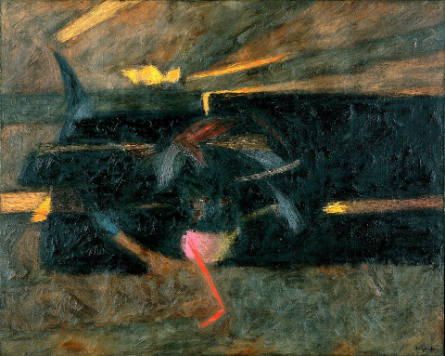
![Sin título, del portafolio Gráfica latinoamericana [Untitled, from the portfolio Latin American Graphic Art]](/internal/media/dispatcher/20166/thumbnail)
Fernando de Szyszlo
not dated
Object number: 1997.48.17/19
![Homenaje a Pallière A [Homage to Pallière A]](/internal/media/dispatcher/15598/thumbnail)
![Los indios del Chaco [The Chaco Indians]](/internal/media/dispatcher/18778/thumbnail)
![Ventana XXVIII [Window XXVIII]. La Perla, Callao, Perú, from the series Ventanas [Windows]](/internal/media/dispatcher/4527/thumbnail)
Fernando La Rosa
1976
Object number: 2016.54
![Pared-Ventana [Wall-Window]. Higuereta, Lima, Perú, from the series Ventanas [Windows]](/internal/media/dispatcher/4530/thumbnail)
Fernando La Rosa
1976
Object number: 2016.52
![Ventana II [Window II]. Máncora, Piura, Perú, from the series Ventanas [Windows]](/internal/media/dispatcher/4540/thumbnail)
Fernando La Rosa
1974
Object number: 2016.53
![Ventana III [Window III]. La Perla, Callao, Perú, from the series Ventanas [Windows]](/internal/media/dispatcher/4542/thumbnail)
Fernando La Rosa
1976
Object number: 2016.51
![Proyecto pecera peces fluorescentes tropicales [Project Fishbowl Flourescent Tropical Fishes]](/internal/media/dispatcher/15271/thumbnail)
Luis Fernando Benedit
1970
Object number: 1982.185