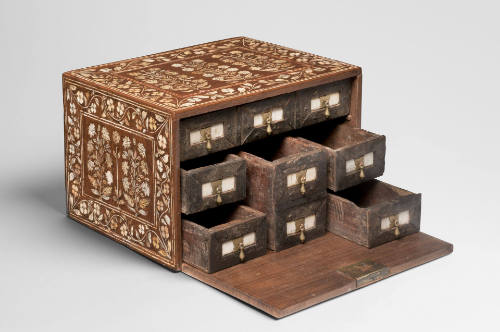


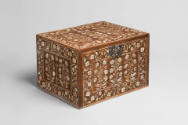
Fall-Front Cabinet
Primary
Unknown Artist
Date17th century
MediumBone or Shell on wood
DimensionsOverall: 7 1/2 × 11 1/4 × 8 3/4 in. (19.1 × 28.6 × 22.2 cm)
Additional Dimension: 20 1/4 in. (51.4 cm)
Additional Dimension: 20 1/4 in. (51.4 cm)
Credit LineBlanton Museum of Art, The University of Texas at Austin, Purchase, 2018.262.a-j
Keywords
Rights Statement
Collection AreaLatin American Art
Object number2018.262.a-j
On View
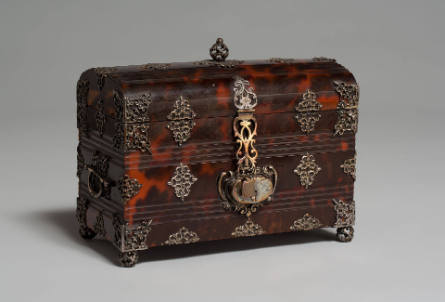
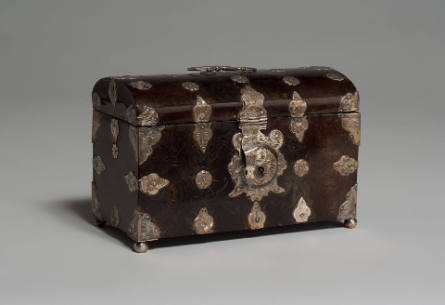
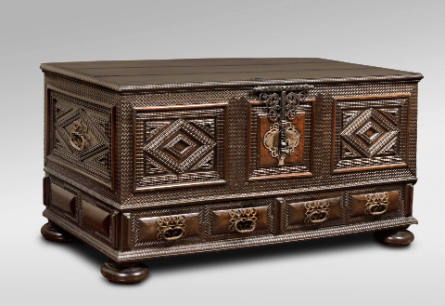
Not on viewPortable fall-front wooden cabinets like this one were made as early as the 1600s to hold personal effects. Whereas the cabinet’s shape, hinge technology, and metalwork are characteristic of German furniture, the intricate inlaid floral decoration and the use of ivory, shell, and bone inlaid in the wood structure are conventional practices of craftsmanship from the Gujarat (Northwest India) and Sindh (Southeastern Pakistan) regions, which at the time were part of the Mughal Empire (1526-1720). Such complex blending of aesthetic traditions took place in Goa, the most productive Portuguese settlement in the Arabian Sea, specifically to satisfy the taste of the European market.
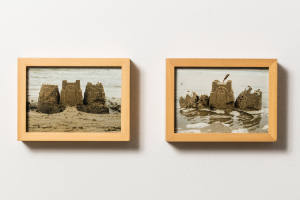
Dario Robleto
1998
Object number: 2017.763.b
Dario Robleto
1998
Object number: 2017.763.c
![Puertas de tríptico con los cuatro evangelistas (verso) y San Pedro y San Pablo (anverso) [Triptych doors with the four Evangelists (front) and St. Peter and St. Paul (back)]](/internal/media/dispatcher/8782/thumbnail)
Unknown Artist
Late 18th century
Object number: 2018.352.a-b
![Precarious, a Palimpsest [Precario, un palimpsesto]](/internal/media/dispatcher/3746/thumbnail)
Cecilia Vicuña
1987-2004
Object number: 2004.93.a-j
![Missão/Missões [Mission/Missions] (How to Build Cathedrals)](/internal/media/dispatcher/12263/thumbnail)

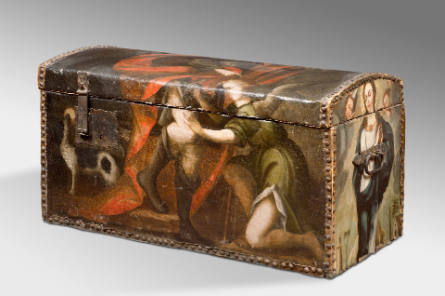
Baúl decorado con pinturas religiosas coloniales [Trunk decorated with religious colonial paintings]
Unknown Artist
18th century
Object number: 2018.347